
ads.txt is one of those foundational pieces of programmatic infrastructure that rarely gets attention until something goes wrong. But as buyers place more emphasis on transparency and supply quality, even small gaps in how inventory is authorised and represented can have real commercial impact. The difference between a clean, well-managed file and a neglected one is often the difference between being confidently bought and quietly filtered out.
There’s a reason ads.txt keeps coming up in publisher audits, monetisation reviews, and buyer conversations, and it’s not because anyone finds it exciting.
It matters because programmatic advertising runs on trust, and trust breaks fast when the supply path looks unclear.
For publishers, ads.txt is one of those rare technical details that seems minor on paper but can have very real commercial consequences in practice. Not because it boosts yield by itself, but because it helps protect the conditions required for healthy demand.
That distinction matters.
Too often, ads.txt gets framed as a compliance task: upload a file, tick a box, move on. In reality, it plays a much bigger role. It helps buyers verify who is allowed to sell your inventory. It reduces ambiguity in the auction. And it signals that a publisher has control over its monetisation setup.
In a market where buyers are constantly filtering supply, that control matters.
ads.txt is not about performance hype. It’s about market clarity.
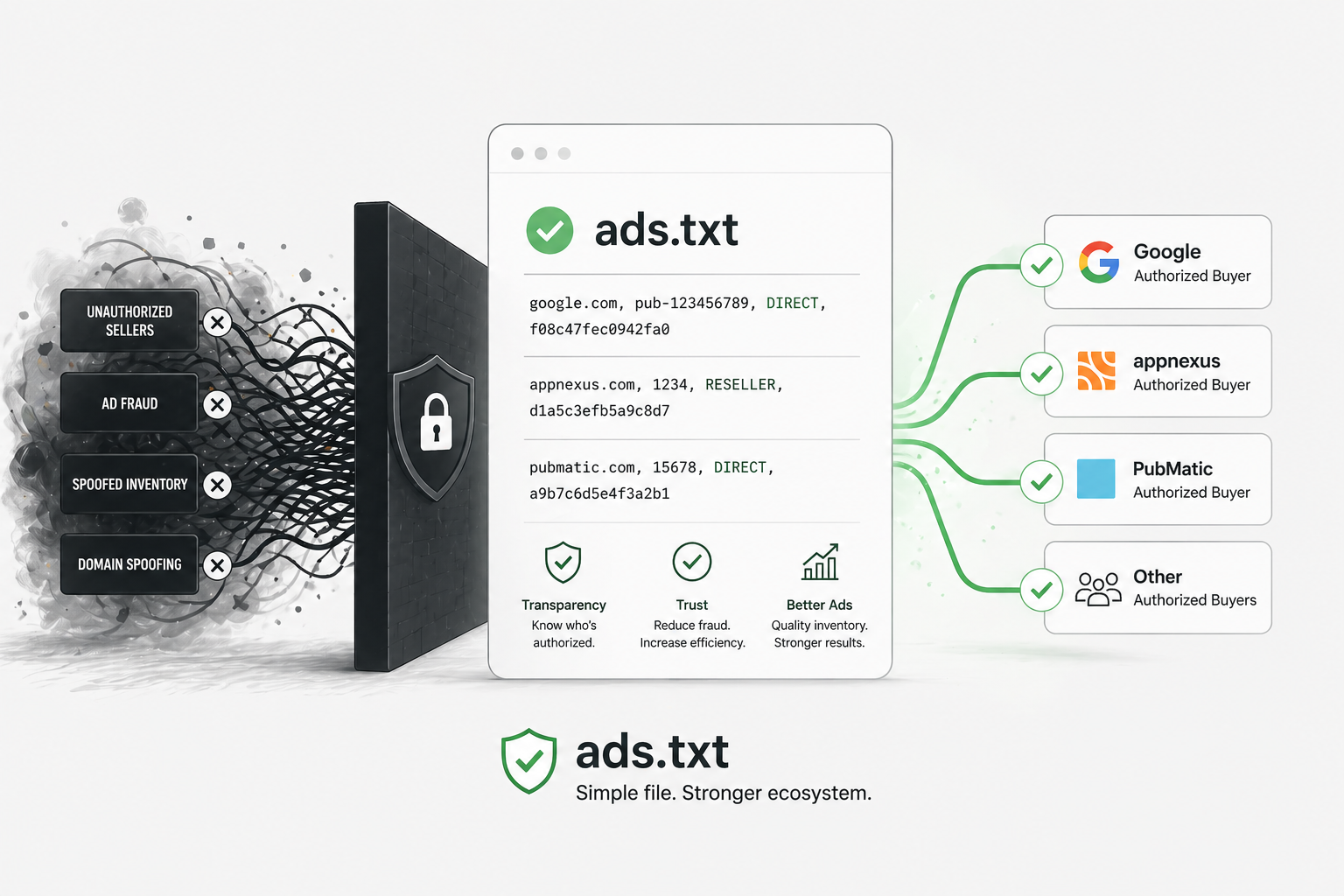
At its core, ads.txt is a publisher-controlled authorisation file. It sits on your domain and tells the market which sales partners are permitted to offer your inventory.
That sounds simple because it is simple.
But simple does not mean unimportant.
Programmatic buying has always had an information problem. Buyers often see the domain, the exchange, the seller ID, the path, but not always with enough confidence to know whether the inventory is being represented cleanly. ads.txt helps close that gap. It gives buyers a way to verify that the seller in the auction is actually supposed to be there.
That is why the file continues to matter in 2026. Not as a trend. Not as a feature. As infrastructure.
Why publishers should care
From a publisher perspective, the value of ads.txt is easy to misunderstand.
What it can do is prevent avoidable revenue loss.
That’s the real issue: ads.txt affects how buyable your inventory looks.
And in an environment where buyers are aggressively evaluating supply quality, being technically available is not the same as being commercially competitive.
The smarter way to think about ads.txt
Publishers should stop thinking of ads.txt as a static admin document and start thinking of it as a reflection of monetisation strategy.
A clean ads.txt file says something important: we know who sells our inventory, why they sell it, and which paths actually matter.
A messy one says the opposite.
That’s why the strongest setups are usually not the longest ones. They’re the clearest ones. Fewer unnecessary reseller lines. Better alignment between direct relationships and listed permissions. More intentional management as partners change.
In other words, ads.txt is not just about access. It’s about discipline.
What usually goes wrong
The biggest ads.txt problems are rarely dramatic. Most are operational.
A publisher adds a partner but never updates the file.
An old reseller remains listed long after it stopped generating meaningful demand.
A seller ID is copied incorrectly.
A relationship is marked as DIRECT when it is actually reseller-based.
The file exists, but no one has reviewed it in months.
None of this looks catastrophic in isolation. That’s exactly why it slips through.
But programmatic leakage often happens quietly. A little less bid density here. A bit more buyer hesitation there. Slightly weaker competitiveness over time. No single red flag, just a gradual erosion of efficiency.
That is what makes ads.txt so easy to underestimate.
Why it matters even more now
In earlier phases of programmatic, publishers could get away with a more passive approach.
Today, the market is less forgiving.
That puts ads.txt in a more strategic position than before.
It is no longer just a technical safeguard against spoofing. It is one piece of a broader trust framework, one that helps buyers assess whether your inventory is being offered through legitimate, efficient, and understandable paths.
And when budgets tighten, those trust signals tend to matter even more.
What good ads.txt management looks like
Strong publishers do not just “have” ads.txt. They maintain it deliberately.
That means:
• reviewing it when new partners are added
• removing stale or unnecessary entries
• validating seller IDs carefully
• making sure relationship types are accurate
• treating the file as part of ongoing yield governance, not as a forgotten setup step
This is where commercial thinking comes in.
Not every authorised path is equally useful.
Not every reseller relationship deserves permanent space.
And not every line in the file contributes positively to how your supply is perceived.
A smart ads.txt strategy is not about having more entries.
It is about having the right ones.
The bottom line
ads.txt remains one of the least glamorous but most important trust signals in publisher monetisation.
It will not transform performance on its own.
But it does shape whether buyers can confidently engage with your inventory.
And that makes it far more valuable than its format suggests.
For publishers, the takeaway is straightforward:
ads.txt is not just a technical requirement. It is a visibility, trust, and revenue-protection layer.
Treat it casually, and you risk making your supply harder to buy.
Treat it strategically, and you give demand a cleaner path to compete.
And in programmatic, clean paths win.