
Connected TV (CTV) has rapidly matured from a high-growth opportunity into a core part of media plans, bringing greater scrutiny to how it delivers and proves value. As investment increases, the focus is shifting from promise to proof, with measurement, transparency, and trust now at the center of the conversation.
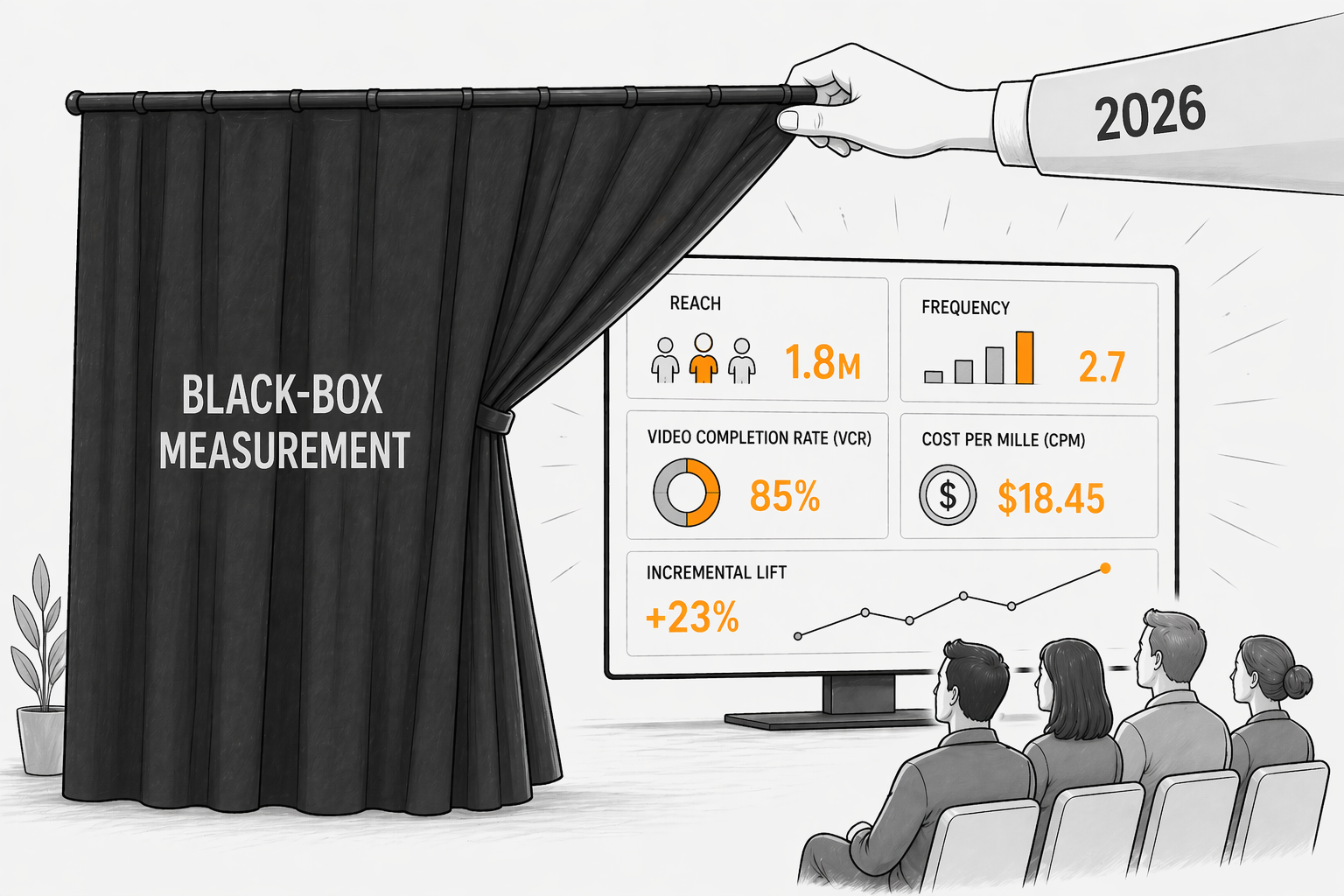
For years, CTV sold a powerful proposition: premium video inventory with digital-style precision and accountability.
That story worked because it aligned with what buyers wanted to believe. Big-screen impact, better targeting, cleaner reporting, more flexibility.
But in 2026, the conversation has shifted.
CTV is no longer being judged like an emerging channel with exciting upside. It’s being judged like a mature one. And mature channels don’t get endless credit for potential. They get examined on methodology, comparability, and business proof.
That’s why I think this is the year buyers stopped accepting black-box measurement.
The standard changed
In the growth phase, CTV benefited from momentum. Budgets moved in because the macro story made sense: audiences were shifting, linear looked less efficient, and CTV felt like the obvious bridge between TV and digital.
But once spend scaled, the measurement cracks became harder to ignore.
And that creates a problem for serious buyers.
Because the question is no longer “Can CTV be measured?”
It’s “Can this measurement be trusted, compared, and defended internally?”
Why black-box reporting is losing tolerance
Black-box measurement fails at exactly the wrong moment: when scrutiny increases.
If a buyer can’t clearly explain how outcomes were calculated, confidence drops.
If reach can’t be meaningfully deduplicated, planning confidence drops.
If attribution looks favourable but can’t be independently interrogated, budget confidence drops.
That matters more now because CTV is no longer a side bet. It’s becoming a core budget line. And core budget lines get challenged by finance, procurement, and cross-channel comparison.
What buyers actually want now
The new brief is not “more dashboards.” It’s better evidence.
Buyers increasingly want:
• transparent methodology
• clearer definitions
• independent verification
• more confidence in incrementality
• results that map to real business impact, not just platform logic
That doesn’t mean the market wants simplicity for its own sake.
It means the market wants measurement that feels like infrastructure, not a sales story.
What happens next
The winners in CTV won’t just be the ones with the most inventory or the loudest positioning.
They’ll be the ones that make buyers feel less exposed.
That’s the real maturity test for CTV now.
Not scale.
Not targeting.
Not even access.
Trust.